CIOs and CISOs should use recent outages and cyber incidents as an opportunity to promote investments in operational and cyber resilience to CEOs and boards of directors. The incidents have eroded trust in technology, requiring CISOs to reassure executive leaders they are not coordinated cyber incidents.
- Gartner client? Log in for personalized search results.
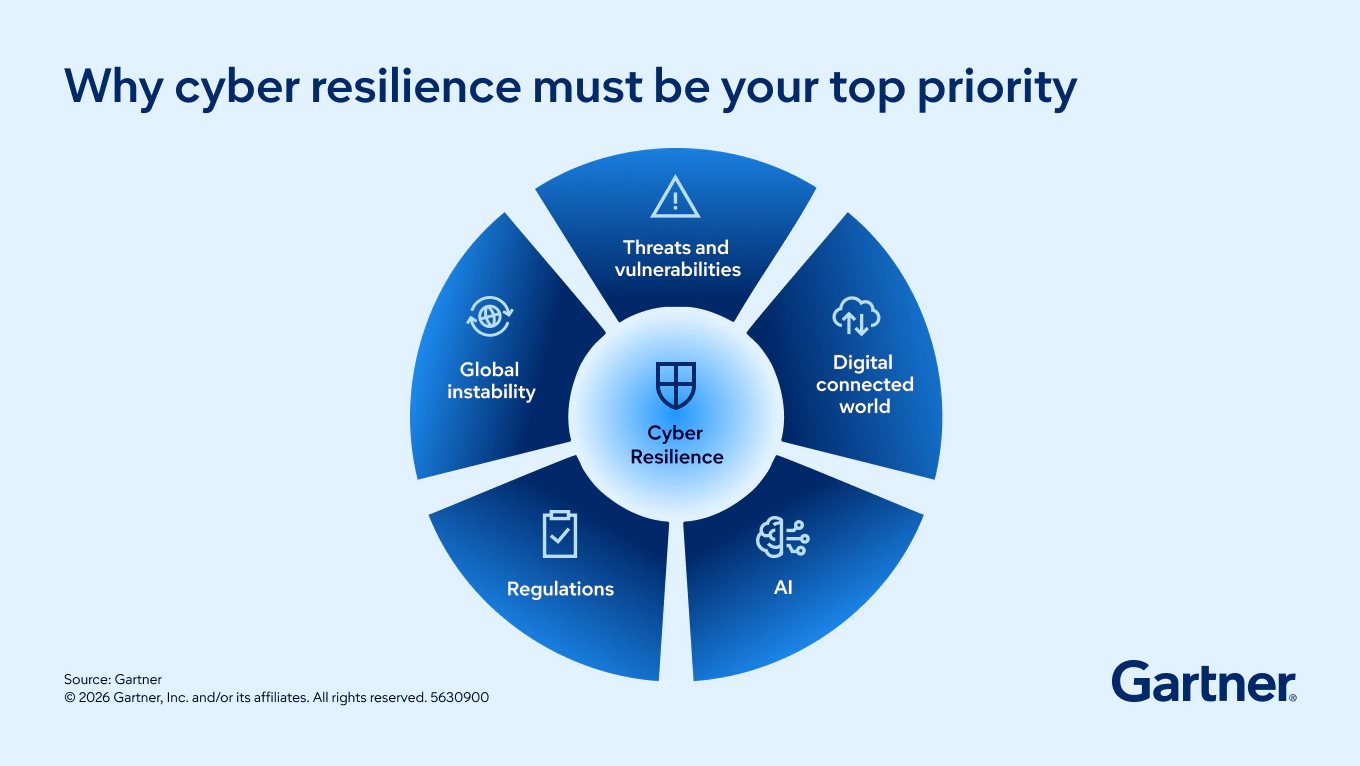
Recent cyber incidents offer cybersecurity leaders a chance to spotlight resilience efforts
In a five-day span starting November 12, 2026, a series of disconnected outages attracted national media attention and destabilized trust in technology. News organizations detailed the growing anxiety from all corners of society, from U.S. senators and city mayors to regular people, that the problems are connected in some sinister way. U.S. Senator Mark Warner, vice chair of the Select Committee on Intelligence, said organizations racing to patch software most likely caused the outages.
Note: This is our first take on recent cyber incidents.



The outages reveal the growing difficulty in operating and maintaining highly interconnected technology systems
When an organization is impacted by an incident, an operational domino effect can ripple across the enterprise. This, in turn, is showcasing the need to fully integrate response and recovery capabilities with enterprisewide business continuity efforts. Recent Analyst Consultations with Gartner clients are pointing to an increased appetite by non-IT executives to learn the cause of these technical failures and cyber incidents.
Your CEO and board of directors have questions for you. You now have the chance to reassure them that these failures and incidents are not part of a major cross-sector, state-actor-led cyberattack. At the same time, this interest in IT outages and cyber incidents gives you a unique opportunity to spotlight your organization’s approach to building cyber and operational resilience and your ability to promptly respond to incidents when they happen.
Cyber incident severity and related media attention are on the rise
Incident severity is rising, due to the increasing complexity of critical dependencies and interconnected technologies. Simultaneously, the political, economic and societal environment remains largely uncertain, adding to the anxiety created in a 24/7 news cycle. The result is that people and companies are highly likely to fall prey to two heuristics: the recency bias (giving more weight to events because they happened recently) and the availability bias (judging things as more likely because examples are easy to recall).
Now is your moment to reinforce the value of your organization’s cybersecurity program to demonstrate cybersecurity’s investments in both prevention and resilience. It’s better to control the narrative than to defend against a lack of action or perceived incompetence.
What CIOs and CISOs should do
The organizations that emerge strongest from this outage-related “media tornado” will be those that establish clear governance, resilient operations and credible crisis communications before the next disruption occurs.
Demonstrate your continued investments in cyber and operational resilience
Many of the outages and incidents that occurred in the past days have showcased how a single dependency, whether hidden or not, can create an operational domino effect across the organization. CIOs and CISOs should:
- Identify security and IT gaps in the most critical business processes in the organization. Focus in particular on the largest technology, cloud and AI concentration risk.
- Identify single-point-of-failure dependencies in the organization, and work with the business to define plans to build redundancy and alternative (including manual) workaround procedures.
- Build specific technical playbooks to address incidents and outages impacting single points of failure.
- Define a multipronged approach to test the resilience of the most critical business processes and assets, including tabletop exercises, red and blue teaming exercises, AI red teaming, chaos engineering and full failover exercises.
- Use executive tabletop exercises to educate executives on the risk trade-offs for specific containment actions, especially for the most drastic ones (i.e., cutting connectivity or using kill switches).
- Revise the disaster recovery, business continuity and cybersecurity incident response plan based on lessons learned from resilience testing.
Formalize escalation mechanisms to ensure that CEOs and boards can promptly activate crisis management
- Formalize escalation mechanisms in the cybersecurity incident response plan. Explain that cybersecurity exclusively escalates the incident up to the CEO and board when a crisis occurs.
- Ensure that the CEO and board know the activation criteria for the crisis management team and crisis communication team.
- Communicate in a clear, nontechnical way what occurred, the known cause (if available), and what measures cybersecurity and IT are taking to minimize impact.
Provide assurance to employees to strengthen organizational resilience
Coordinate with the chief communications officer and chief human resources officer to draft a one-page communication for distribution to employees, detailing your evaluation of the current environment, and outlining containment actions that cybersecurity and IT have taken to minimize harm. Ask PR if they already have preapproved templates for internal communication.
Prominently communicate the role that the broader workforce plays
- Instruct employees to promptly report any issues using the appropriate channels. Use the message to reiterate where employees can submit any IT tickets.
- Prompt employees to familiarize themselves with their business unit’s downtime and manual workaround procedures.
- Remind employees to sign up for the organization’s emergency notification platform (if any is used to communicate during crises).
- Require employees to participate in regular cybersecurity awareness training.
Attend a Conference
Accelerate growth with Gartner conferences
Gain exclusive insights on the latest trends, receive one-on-one guidance from a Gartner analyst, network with a community of your peers and leave ready to tackle your mission-critical priorities.

Drive stronger performance on your mission-critical priorities.