Voice is no longer limited to simple scripts and call routing. AI can now resolve more complex conversations autonomously.
- Gartner client? Log in for personalized search results.
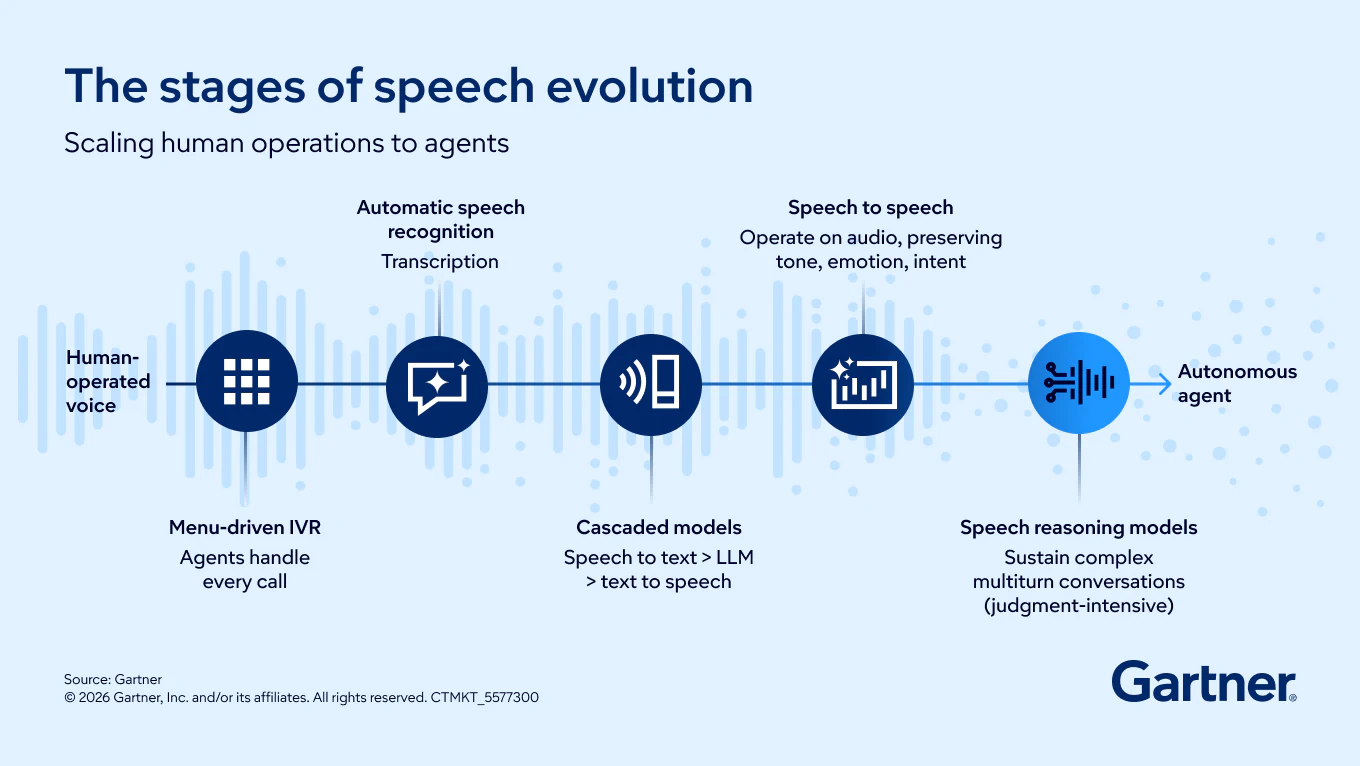

Voice shifts from automation gap to strategic channel
For years, enterprises invested in voice automation with mixed results. Interactive voice response systems and earlier generations of conversational AI could recognize words, but they struggled to understand context, manage interruptions and resolve complex issues. As a result, many high-value conversations still required human intervention.
Speech reasoning models, one of the Gartner Top 10 Strategic Technology Trends for 2027, change that equation. Rather than converting speech to text before interpreting it, these models apply reasoning directly to audio. By 2030, more than 70% of enterprise voice interactions will be handled autonomously, up from less than 10% in 2026. The shift goes beyond improved speech recognition. It represents a move from understanding language to understanding conversations.
“Legacy voice AI is used to understand words. Speech reasoning models understand contextual conversations,” says Alex Coqueiro, Senior Director Analyst at Gartner.
You might also like this webinar: The Gartner Top Strategic Technology Trends for 2027
Why speech reasoning models matter now
Speech reasoning models create new opportunities, but they also raise important decisions about where and how organizations can trust autonomous voice systems.
Voice automation moves beyond scripted interactions
Voice remains the highest-volume interaction channel for many organizations, yet it has historically been one of the least automated. Speech reasoning models retain context across multiturn interactions, recover from interruptions and ambiguity, and execute multistep actions within a conversation. This makes it possible to automate judgment-intensive interactions that previously required human involvement.
The opportunity extends well beyond customer service. The 2026 Gartner Navigating the Evolving Role of the CIO Survey found that among technology solutions that use voice input as a data source, only 18% of use cases are purely customer-facing, while 35% are internal and 47% span both internal and customer-facing scenarios.
Early deployments illustrate the potential. In healthcare settings, speech reasoning models can identify contextual inconsistencies in patient-reported symptoms. In financial services environments, they can detect intent-based compliance violations that static keyword monitoring may miss. In HR functions, they can help resolve complex benefits and employee grievance discussions that exceed the capabilities of scripted chatbots.
The value extends beyond cost reduction
The potential business impact goes beyond efficiency. Speech reasoning models can autonomously resolve 30% to 80% of inbound interaction volume, reduce costs across voice-based functions by 40% to 90%, and resolve interactions eight to 10 times faster than human-handled equivalents.
More importantly, they can help organizations scale service delivery without response times slowing as demand increases. Faster, more consistent resolution can help absorb demand spikes, extend service coverage and maintain service levels without increasing staffing proportionally.
As reasoning capabilities improve, speech reasoning models are expanding into situations that once required human judgment by default, narrowing the range of interactions that require escalation.
Build the right foundation before scaling
Organizations should not assume speech reasoning models are ready for unrestricted deployment. Challenges include accuracy validation, governance requirements, privacy obligations and the gap between vendor benchmarks and real-world performance. By 2028, voice AI agents deployed without the ability to detect and correct a mistake will see abandonment approach 70% as compounding errors erode trust.
Leaders looking to capture the benefits of autonomous voice interactions as the technology matures should take three practical steps now:
Draft consent, privacy and audit-logging requirements before launching voice pilots, and assign clear compliance ownership.
Inventory high-volume recorded voice interactions and establish labeling standards ahead of domain adaptation efforts.
Classify voice interactions by complexity so conversations can be routed appropriately between low-latency tiers and deeper reasoning models.
Speech reasoning models FAQs
What are speech reasoning models?
Speech reasoning models apply domain-specific judgment directly to audio and determine what action to take based on what was said. They reason and respond on audio without relying on a traditional speech-to-text workflow.
Why are speech reasoning models different from earlier voice AI?
Earlier voice AI focused primarily on recognizing and transcribing speech. Speech reasoning models maintain context, recover from interruptions and ambiguity, and execute multistep actions that enable more complex conversations.
What should CIOs do about speech reasoning models today?
Organizations should establish governance and privacy requirements, inventory and organize voice data, and classify interactions by complexity before expanding into larger deployments.
Attend a Conference
Experience CIO and IT Executive conferences
With exclusive insights from Gartner analysts on the latest trends, sessions curated for your role and unmatched peer networking, Gartner conferences help you accelerate your priorities.
22 – 23 Feb 2027
Gartner CIO Leadership Forum
Phoenix, AZ

Drive stronger performance on your mission-critical priorities.