Organizations need AI that can support better decisions with greater accuracy, transparency and trust.
- Gartner client? Log in for personalized search results.

AI’s biggest limitation isn’t language anymore
Generative AI has transformed how organizations create content and interact with information. But as leaders push AI into more strategic decisions, a critical limitation has emerged: Large language models (LLMs) were not designed for rigorous forecasting, simulation or quantitative analysis.
Large quantitative models (LQMs), one of the Gartner Top 10 Strategic Technology Trends for 2027, are emerging to fill that gap. Designed to process large-scale numerical, scientific and simulation data, they help organizations move from reactive decision making to proactive analysis. By 2030, Gartner predicts that LQMs will replace LLMs in 25% of forecasting and modeling tasks.
“Large quantitative models can boost the accuracy and reliability of AI solutions by combining symbolic regression, physics-informed neural networks and post-hoc explainable AI frameworks, making it easier to validate the predictions behind every critical forecast,” says Samantha Searle, Senior Director Analyst at Gartner.
You might also like this webinar: The Gartner Top Strategic Technology Trends for 2027
Why quantitative AI changes enterprise decision making
As organizations look beyond content generation, they need AI systems that can support decisions with greater accuracy, reliability and transparency.
Language AI has a forecasting problem
Many organizations have treated LLMs as a universal AI solution. However, these models rely on probabilistic token prediction and have limited capabilities for calculations and large-scale numerical analysis.
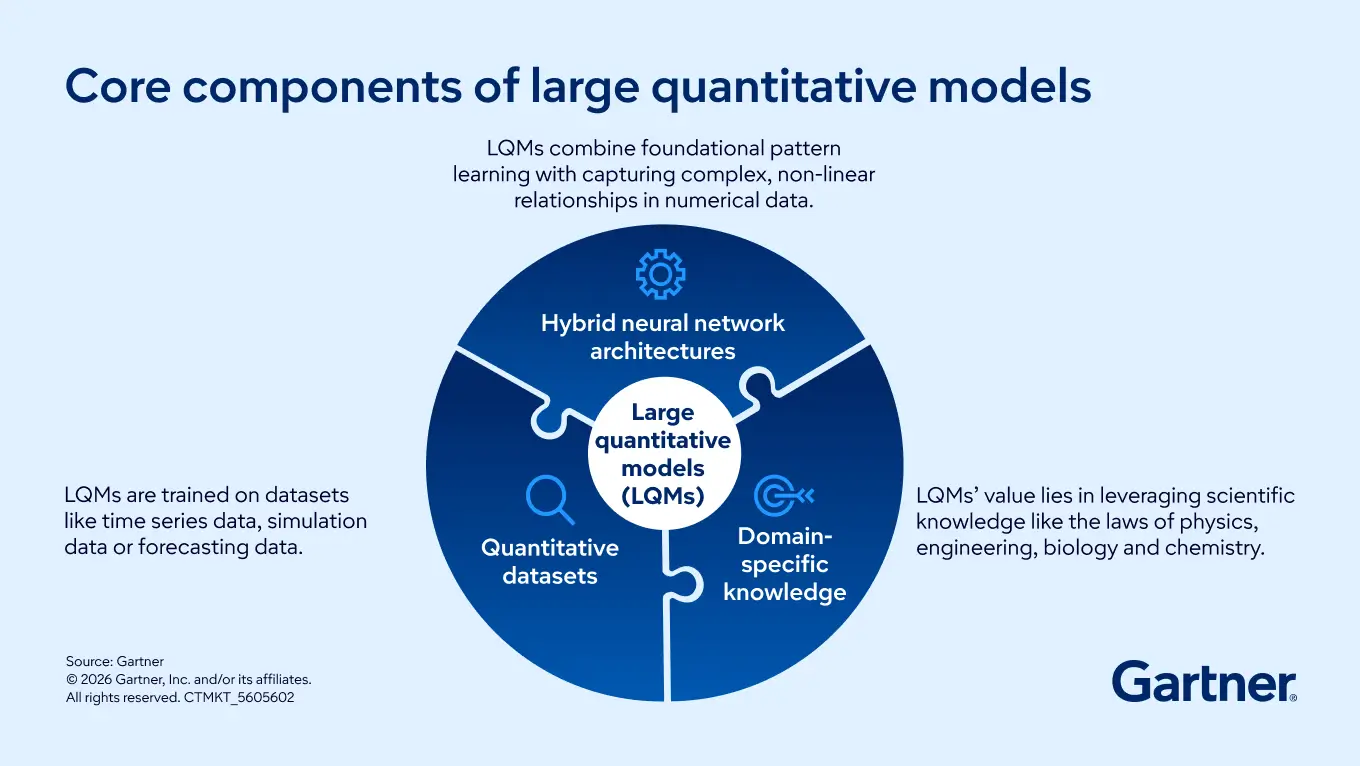
Large quantitative models are trained on numerical, temporal, scientific and simulation data and provide the analytical capabilities needed for risk modeling, performance optimization and scenario analysis. Whether modeling supply chain disruptions, optimizing investment portfolios or analyzing energy demand, LQMs are built for the quantitative tasks that challenge language models.
However, rather than replacing LLMs altogether, LQMs create the most value as part of composite AI solutions. LLMs provide contextual understanding and language-based interaction, while LQMs provide the mathematical rigor needed to translate complex data into actionable insights.
Decision support becomes more predictive
The significance of large quantitative models extends beyond improving calculations. Use case opportunities for LQMs exist across industries including financial services, healthcare, pharmaceuticals, supply chain, energy and agriculture. Organizations can use LQMs to optimize operations, assess risks, improve demand forecasting and evaluate potential outcomes before they occur. This ability to test scenarios in advance can improve both business agility and decision quality.
Trust is equally important. Large quantitative models improve reliability and traceability through techniques such as symbolic regression, physics-informed neural networks and explainable AI frameworks. Unlike traditional black-box models, they combine mathematical constraints with specialized analytical techniques that help validate outputs and explain results.
Yet, realizing these benefits requires overcoming significant adoption challenges. The accuracy of LQMs depends on access to high-quality data. Organizations may also need people with specialized quantitative talent to interpret outputs and manage deployments. In addition, integrating these models can require high-performance computing infrastructure, particularly for complex analyses. Successful adoption depends not only on the technology itself but also on strong data practices, governance and operational readiness.
Actions leaders should take now
Organizations do not need to replace existing AI investments to benefit from large quantitative models. Instead, they should focus on building the capabilities needed to support quantitative AI while identifying opportunities for near-term value.
Leaders should:
- Target specific forecasting and simulation use cases where mathematical precision can create immediate business value and competitive advantage.
- Exploit hybrid AI architectures by combining existing LLMs with LQMs, allowing language models to deliver contextual understanding while quantitative models provide analytical rigor.
- Adapt ModelOps strategies to continuously monitor deployments, maintain high-quality data inputs and prevent model overfitting.
- Establish robust governance by mandating collaboration among IT, data science and business teams to securely integrate LQMs into the technology stack.
- Prepare for specialized requirements by addressing data readiness, infrastructure needs and the talent required to interpret quantitative outputs.
Large quantitative models FAQs
What are large quantitative models?
Large quantitative models are AI models designed to process and analyze quantitative data. They support forecasting, simulation, risk analysis, optimization and scenario planning using large-scale numerical, scientific and time-series datasets.
How do large quantitative models differ from large language models?
Large language models are designed to work with language and generate text through probabilistic prediction. Large quantitative models are designed to process mathematical, scientific and financial data, enabling forecasting, modeling and quantitative analysis.
How will organizations use large quantitative models?
Organizations can use large quantitative models for market risk modeling, statistical forecasting, supply chain optimization, demand planning, predictive maintenance, energy forecasting, scientific research and pharmaceutical development. Gartner predicts that by 2030, LQMs will replace LLMs in 25% of forecasting and modeling tasks.
Attend a Conference
Experience CIO and IT Executive conferences
With exclusive insights from Gartner analysts on the latest trends, sessions curated for your role and unmatched peer networking, Gartner conferences help you accelerate your priorities.
22 – 23 Feb 2027
Gartner CIO Leadership Forum
Phoenix, AZ

Drive stronger performance on your mission-critical priorities.