Organizations must move from policy‑based governance to enforceable technical controls as AI expands and evolves.
- Gartner client? Log in for personalized search results.
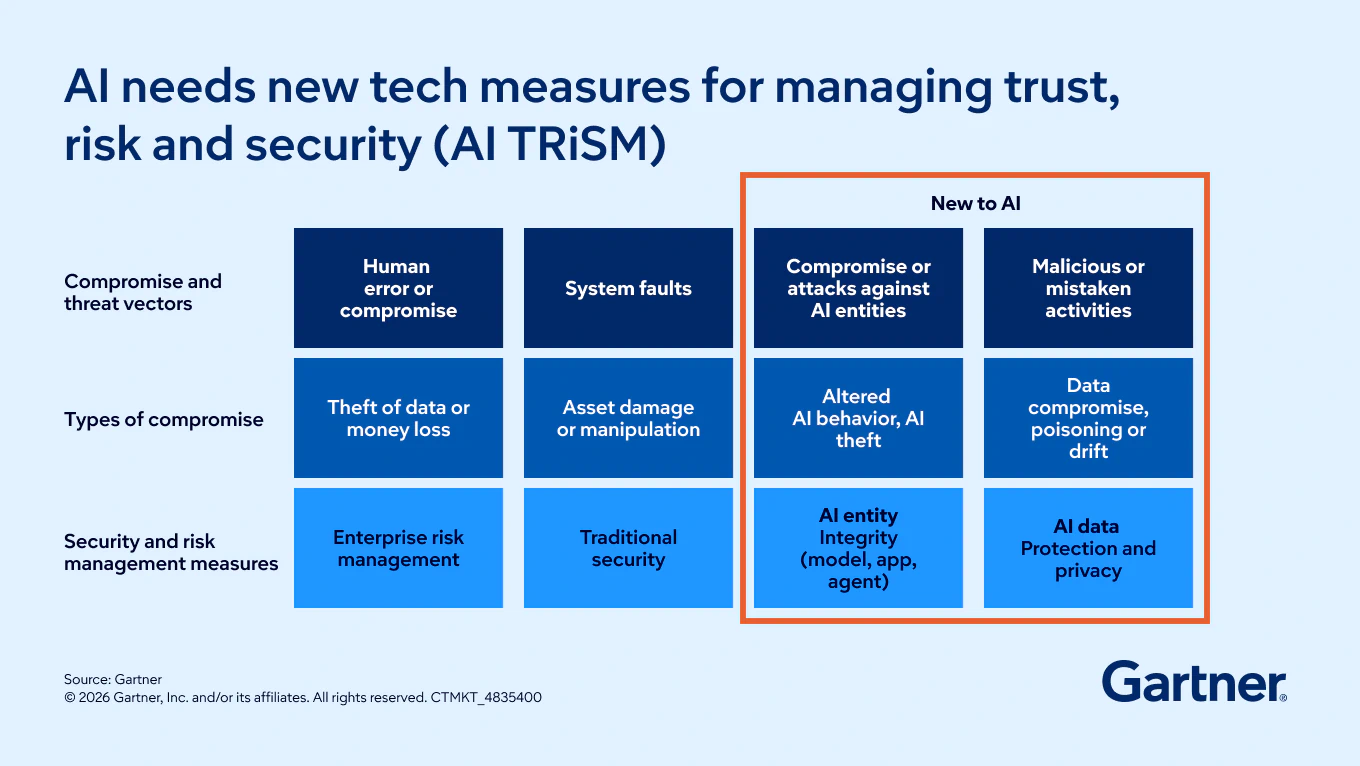

AI governance is evolving as scale and complexity increase
AI adoption is accelerating across enterprises, introducing new levels of scale, complexity and interdependence across models, applications and workflows.
At the same time, many organizations still treat AI governance as something to address after systems are deployed. This reactive approach makes governance difficult to embed into workflows, leading to gaps in oversight and increased exposure to security, compliance and operational risks.
As AI ecosystems expand — spanning data, models, applications and business processes — governance requirements are evolving. Gartner insights shows organizations must move beyond high‑level policies toward approaches that are embedded, continuous and enforceable across the enterprise.
Why AI governance must evolve beyond policy
Traditional governance approaches rely on policies, training and periodic oversight. These establish intent — but they do not ensure AI systems behave as expected in real time. As AI becomes more distributed and increasingly autonomous, governance must evolve into an operational, continuously enforced capability that enables AI Trust Risk and Security.
AI introduces risks that policies alone can’t manage
AI systems introduce risks that emerge during live interactions and decision making, requiring more than static controls. These risks span multiple layers of the AI life cycle, including:
Data risk, including exposure, misuse or improper access
Output risk, including inaccurate, biased or harmful outcomes
As AI systems operate, these risks are dynamic and context-dependent. Managing them effectively requires continuous monitoring, validation and enforcement — not just predefined policies.
AI is increasingly embedded and autonomous
AI is no longer isolated. It is embedded across enterprise applications, SaaS platforms and business workflows, increasing both the reach and complexity of governance requirements.
At the same time, the emergence of agentic AI — capable of taking actions with limited human intervention — is fundamentally altering risk profiles and increasing the need for adaptive oversight.
As AI becomes both more pervasive and more autonomous, organizations must improve visibility into where AI operates and ensure stronger controls over how it behaves across environments.
Most organizations still rely on policies instead of enforceable controls
Despite these shifts, many organizations continue to rely primarily on policies, training and limited rollout strategies to manage AI risk.
While these approaches remain important, they do not provide continuous verification or enforcement during AI operation. As a result, a gap emerges between governance intent and execution — particularly as AI adoption expands and systems operate with greater autonomy.
AI TRiSM enables governance that works in practice
AI trust, risk and security management (AI TRiSM) provides the technical foundation and controls to operationalize modern AI governance. It enables organizations to embed oversight, controls and validation mechanisms across the AI lifecycle, ensuring systems are trustworthy, reliable and secure.
Rather than relying on static policies, AI TRiSM introduces capabilities for continuous monitoring, validation and runtime enforcement. These capabilities allow organizations to detect anomalies, enforce policies and maintain compliance as AI systems operate.
Gartner insights shows that effective AI governance depends on continuous monitoring and dynamic policy enforcement — enabling organizations to balance innovation with accountability at scale.
What CIOs and AI leaders should do now
To align governance with the realities of modern AI, CIOs and AI leaders should do the following:
Define enforceable AI policies aligned to risk, regulation and ethics.
Establish full visibility by discovering and inventorying AI across the enterprise.
Strengthen information and access governance to protect AI data and access.
Implement AI TRiSM capabilities to enable continuous monitoring, validation and enforcement across the AI life cycle.
Evolve toward ongoing governance processes that operate alongside AI systems in real time.
AI governance is no longer just about defining rules. It requires the ability to continuously enforce those rules as AI systems operate across increasingly complex and autonomous environments.
AI governance FAQs
What is AI TRiSM?
AI TRiSM (AI trust, risk and security management) is a framework and set of technical capabilities that ensure AI systems are trustworthy, secure and compliant through continuous monitoring, validation and enforcement.
Why are policies not enough?
Policies establish expectations but cannot enforce behavior during real-time AI operations, where risks emerge dynamically.
How does AI TRiSM improve governance?
It embeds monitoring and enforcement directly into AI systems, enabling continuous, operational governance instead of periodic oversight.
Attend a Conference
Accelerate growth with Gartner conferences
Gain exclusive insights on the latest trends, receive one-on-one guidance from a Gartner analyst, network with a community of your peers and leave ready to tackle your mission-critical priorities.

Drive stronger performance on your mission-critical priorities.