Faster forecasts create value only when they lead to better decisions.
- Gartner client? Log in for personalized search results.

Forecast speed is no longer the challenge
AI is making it possible to refresh forecasts faster than ever before, giving finance leaders access to more frequent updates, new scenarios and earlier warning signals.
Still, forecasting speed is beginning to outpace leaders’ ability to confidently interpret change, which creates an entirely new challenge.
“Rolling forecasts that outpace trust and interpretability undermine the CFO’s credibility as a decision leader, limiting their ability to steer capital, guide trade-offs and confidently lead through sustained volatility,” says Regina Crowder, Senior Director Analyst at Gartner.
You might also like this webinar: Design Forecasting Workflows for Continuous and Agentic Planning
The goal is more confident, well-informed decisions
Many organizations still measure forecasting success by speed. However, forecasting creates value when it helps leaders make confident decisions under uncertainty.
This shift changes the role of forecasting itself. Rolling forecasts are becoming continuously refreshed systems that support decisions, rather than periodic planning tools. Instead of updating assumptions, they help leaders navigate uncertainty and make more confident decisions.
Not every forecast update deserves a decision
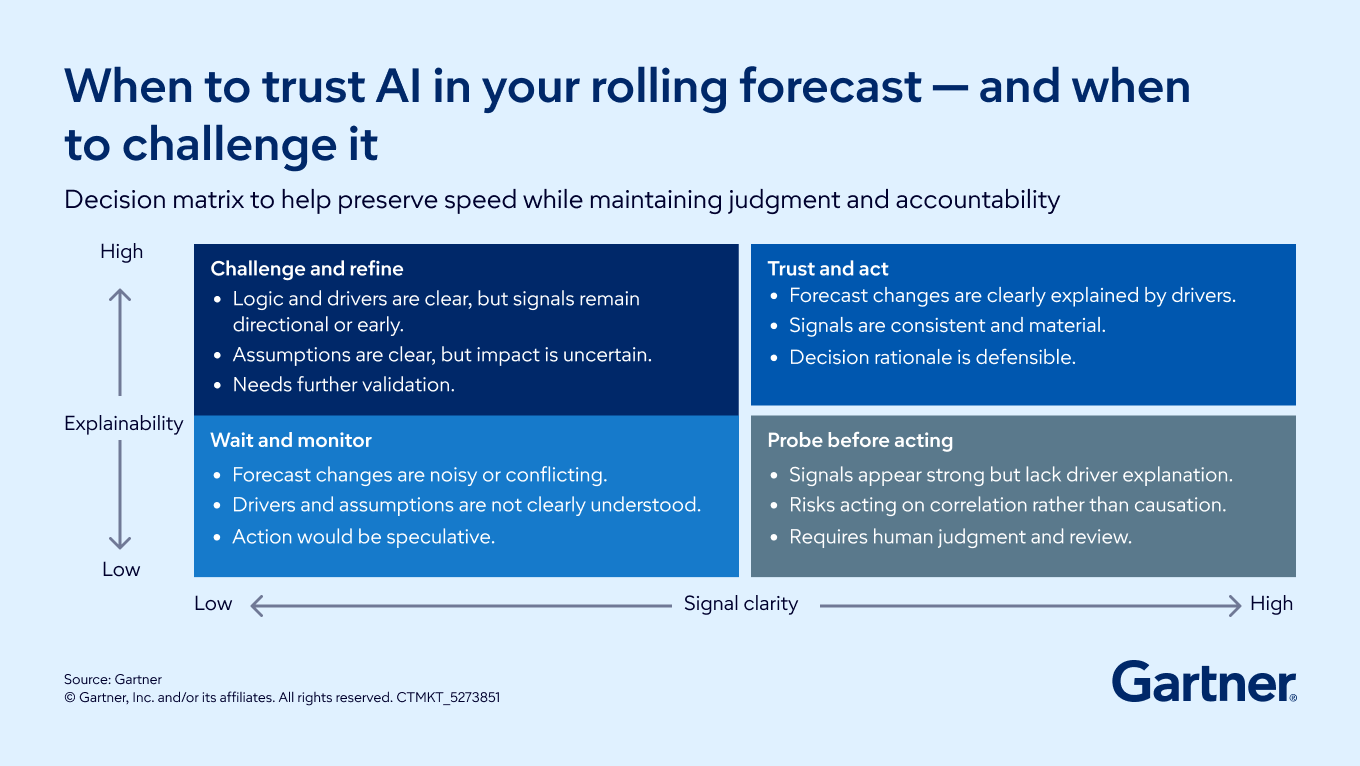
Organizations gain more value when they establish clear expectations around which forecast changes require action and which should simply be monitored. This helps leaders focus on the signals that matter most.
AI can surface signals, refresh scenarios and identify emerging risks in near real time. More information alone does not improve decisions. Leaders must determine whether new information warrants action, further observation or additional scrutiny.
Explainability builds decision confidence
Leaders are more likely to trust forecasts when they understand what changed and why. Forecast outputs should be linked to recognizable business drivers and supported by transparent assumptions that can be clearly communicated to stakeholders.
When forecast changes cannot be explained, confidence deteriorates. When they’re connected to an understanding of business conditions, leaders are better positioned to make decisions with confidence.
Guardrails separate signals from noise
As forecast frequency increases, organizations need mechanisms that help distinguish meaningful changes from normal volatility. Decision triggers, materiality thresholds, confidence bands and challenge processes help leaders determine when action is required and when patience is the better response.
These guardrails reduce the risk of overreacting to short-term fluctuations while preserving the ability to respond quickly when meaningful changes occur. Just as important, they create consistency in how leaders evaluate new forecast information.
Uncertainty cannot be eliminated, but organizations can create a disciplined process for determining when signals should trigger action, or when they should simply inform future decisions.
The organizations that gain the most value from AI-enabled forecasting help leaders interpret change and align on action. As volatility continues to increase, forecasting’s value will be measured by the quality of decisions it supports.
AI forecasting FAQs
Why aren’t faster AI forecasts producing faster decisions?
More frequent forecast updates can create uncertainty if leaders do not understand which signals require action. Forecast speed creates value only when organizations can confidently interpret forecast changes and respond appropriately.
What is decision-ready forecasting?
Decision-ready forecasting helps leaders determine when to act, when to wait and when to challenge forecast signals. It prioritizes decision quality, explainability and confidence rather than forecasting speed alone.
How can CFOs build trust in AI-generated forecasts?
Trust is built through explainability, decision guardrails and clear action thresholds. Organizations should connect forecasts to understandable business drivers, establish decision triggers and create consistent processes for evaluating forecast changes.
Attend a Conference
Join Gartner analysts and your peers to accelerate growth
Gather alongside your peers in National Harbor to gain insight on emerging trends, receive one-on-one guidance from a Gartner analyst and create a strategy to tackle your priorities head-on.
2 – 4 Jun 2027
Gartner Finance Symposium/Xpo™
National Harbor, MD

Drive stronger performance on your mission-critical priorities.