Organizations need better context, not just more agents, to realize the promise of autonomous AI.
- Gartner client? Log in for personalized search results.

AI agents are scaling faster than enterprise knowledge
Organizations are investing aggressively in AI agents, but many are struggling to turn that investment into business value. According to Gartner, 42% of enterprises plan to deploy AI agents by the end of 2026, yet only 22% currently capture significant value from generative AI. As organizations push toward greater autonomy, fragmented knowledge, hallucinations and rising compute costs are creating a growing gap between AI adoption and AI outcomes.
AI context platforms, one of the Gartner Top 10 Strategic Technology Trends for 2027, are designed to help close that gap. These platforms organize and govern enterprise knowledge so AI agents can access the specific business context they need to make reliable decisions, execute workflows and operate efficiently at scale.
“AI context platforms empower AI agents with the knowledge required for consistently reliable, cost-efficient and contextually relevant decision making,” says Andrés García-Rodeja, Senior Director Analyst at Gartner.
You might also like this webinar: The Gartner Top Strategic Technology Trends for 2027
How leaders can build a foundation for trustworthy AI
As organizations move beyond AI assistants toward autonomous agents, managing business context becomes a strategic priority. AI context platforms help organizations create the knowledge foundation required to improve reliability, reduce costs and scale agentic AI with greater confidence.
Turn business knowledge into machine-readable context
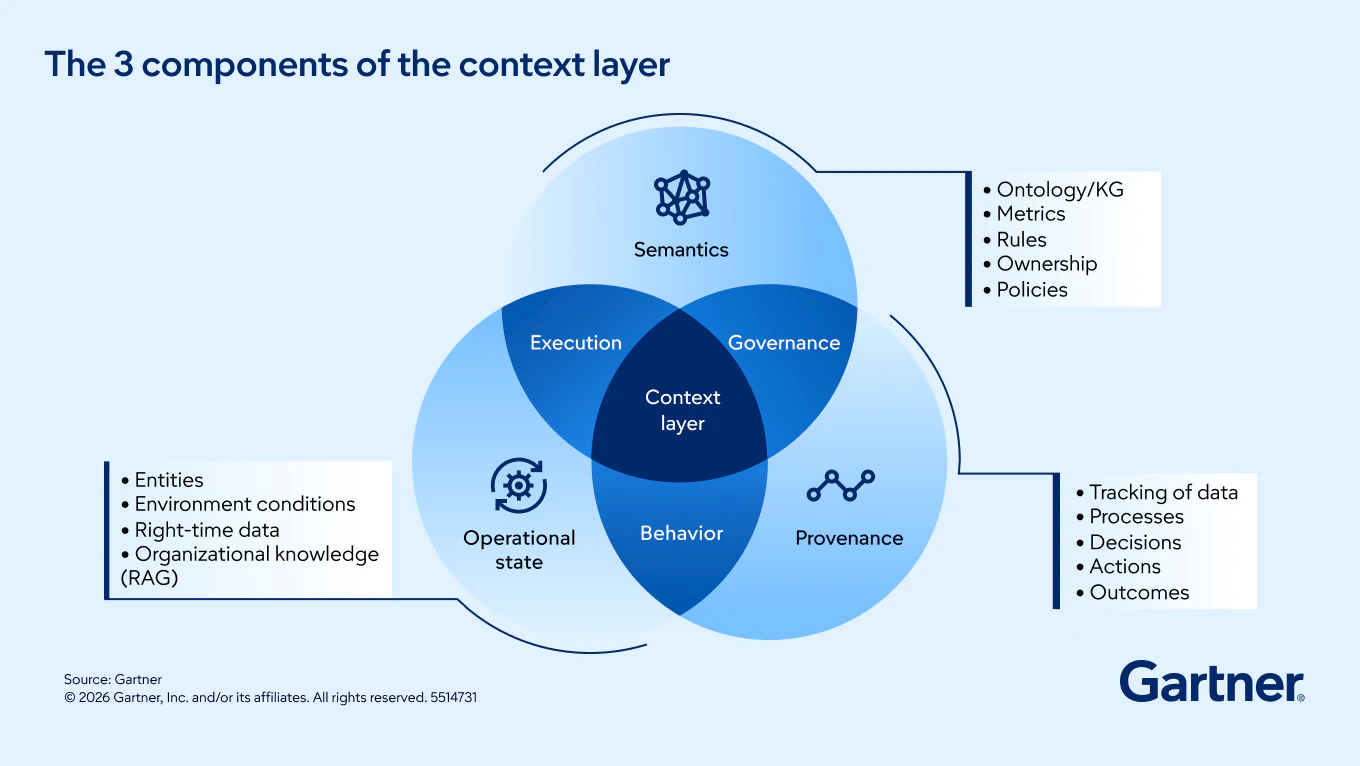
Raw data alone cannot support autonomous AI. To interpret intent, follow policies and execute workflows accurately, agents require structured business knowledge. AI context platforms provide that foundation by constructing and delivering semantically organized knowledge through assets such as taxonomies, ontologies and knowledge graphs. An enterprise context layer combines semantics, operational state and provenance, giving agents the business meaning, situational awareness and traceability needed to operate reliably.
Gartner predicts that, by 2027, organizations that prioritize semantics in AI-ready data will increase agentic AI accuracy by up to 80% and reduce costs by up to 60%.
Avoid the risks of fragmented context
Today many organizations still build context separately for each AI agent, creating duplicate knowledge structures, inconsistent outcomes and operational inefficiencies.
Without governed retrieval, agents are more likely to hallucinate, misinterpret business rules and consume unnecessary computing resources. Unfiltered context can also expose sensitive information and increase costs, limiting the scalability of agent initiatives.
Leaders should also be cautious when evaluating vendors that promise a complete AI context platform solution, as no single provider currently offers it. Many vendors position context as a data storage capability rather than a broader approach to managing semantic, operational and traceability requirements. Organizations that treat context as an enterprise capability rather than a product feature will be better positioned to support future agentic AI deployments.
Treat context management as a business discipline
Building a context platform is not a one-time technology project. Organizations that invest in context, not just agents, will be better positioned to improve trust, efficiency and scalability as agentic AI adoption expands. Leaders should take the following actions:
- Create a phased roadmap by centralizing unstructured policies first, then progressing toward semantic consolidation and rule-based automation.
- Accelerate semantic modeling by combining AI-assisted creation with human expertise.
- Develop specialized expertise through targeted hiring or upskilling in semantic standards such as RDF, OWL, SHACL and SPARQL.
- Establish shared ownership between IT and business teams.
- Strengthen governance controls for data quality, security, traceability and auditability.
AI context platforms FAQs
What are AI context platforms?
Gartner defines AI context platforms as software that enables data and AI engineering teams to construct, govern and deliver semantically organized knowledge to AI agents and other AI applications and services. The platform’s knowledge assets include taxonomies, ontologies and knowledge graphs that capture and connect business meaning, relationships, rules, policies and constraints. The platforms process structured data and unstructured content and map them to semantic models in order to enable the processing and delivery of context at query time as grounded, cited output.
Why are AI context platforms important for agentic AI?
AI context platforms help address the gap between general knowledge encoded in foundation models and proprietary, enterprise-specific knowledge and context required for reliable action. By delivering governed, task-specific context, they help AI agents capture, model and deliver proprietary knowledge, while grounding them in enterprise reality.
How can organizations get started with AI context platforms?
Gartner recommends establishing a phased maturity roadmap, accelerating semantic modeling with AI-assisted creation, building specialized knowledge engineering expertise, creating shared ownership between business and IT teams, and implementing strong governance controls for data quality, security and auditability.
Attend a Conference
Experience CIO and IT Executive conferences
With exclusive insights from Gartner analysts on the latest trends, sessions curated for your role and unmatched peer networking, Gartner conferences help you accelerate your priorities.
22 – 23 Feb 2027
Gartner CIO Leadership Forum
Phoenix, AZ

Drive stronger performance on your mission-critical priorities.