To achieve the strongest ROI, build agents to execute specific business processes, while avoiding common pitfalls that stall maturity.
- Gartner client? Log in for personalized search results.

The biggest agentic AI opportunity is specialization
Many organizations are pursuing agentic AI to improve productivity, automate work and accelerate decision making. Yet, Gartner analysis of 107 agentic AI deployments suggests that the greatest business value comes from a more focused approach than many leaders expect.
Rather than relying on broad, general-purpose agents, Gartner predicts that by 2028, 80% of all tangible ROI from agentic AI will come from specialized, domain-specific agents instead.
“Organizations must scale successful domain-specific agents into enterprisewide deployments for cross-functional workflows,” says Robert Hetu, Distinguished Vice President Analyst at Gartner.
Move from basic support to strategic autonomy
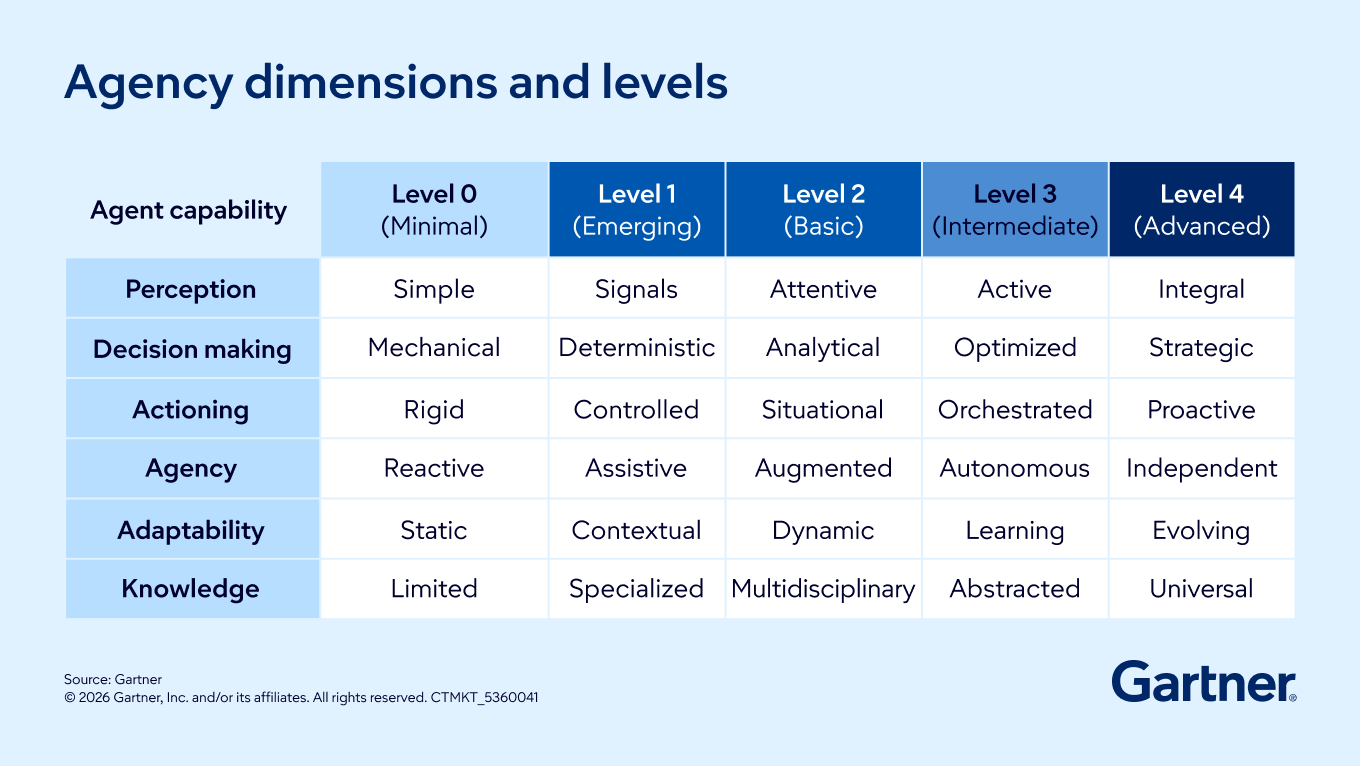
To improve understanding of the maturity of agentic AI use cases, Gartner compared more than 100 publicly available agentic AI examples across industries. The findings showed that organizations achieve the greatest value when they match the complexity of their business problem with the appropriate level of agentic autonomy. In some cases, general-purpose models are a great way to speed adoption, but only when the requirements are more general in nature.
Put agents to work inside business processes
Across industries, organizations are effectively using agents to automate parts replenishment, manufacturing analysis and equipment diagnostics. For example, an industrial services provider achieved a $3 million annual ROI and returned 90,000 hours to technicians through a digital worker that automates parts ordering.
What do these success stories have in common? A focus on execution. These agents move beyond offering suggestions and operate within enterprise workflows, complete tasks and produce measurable operational outcomes.
Prioritize domain-specific agents
The greatest returns come when organizations scale successful domain-specific agents across functions and workflows. Some use cases driving significant ROI include:
Healthcare claims: An AI agent reviews medical claims, applies clinical and coding rules and corrects diagnosis errors before payment.
Workers’ compensation insurance: An agentic platform purpose-built for insurance claims reviews medical and legal records to identify claims that may be safely rejected.
Prior authorization processing: A domain-specific pipeline that integrates directly with electronic health records (EHRs) reviews requests against medical policies and delivers immediate, auditable decisions.
Avoid common pitfalls that prevent maturity
Specialized agents alone don’t guarantee results. Leaders should avoid these six common mistakes that can limit ROI and stall maturity:
Agent washing: Mistaking basic AI assistants for agents with greater agency for decision making can create unrealistic expectations and lead to fragmented deployments.
Weak data and architecture foundations: Poor data quality or system architecture can prevent AI initiatives from delivering expected value.
Agent sprawl: Deploying too many unmanaged agents without adequate oversight can lead to fragmented governance, unauthorized automated actions and elevated security risk.
Unmanaged AI token costs: Uncontrolled API consumption can drive up costs and pose operational, financial and security threats.
Overestimation of reliability: Removing human-in-the-loop oversight can cause context loss, goal drift, repeated error loops and compounding mistakes.
Insufficient change management: Scaling from pilot to enterprise without redefining roles, training users and addressing job security concerns can undermine outcomes.
Agentic AI success is not simply about deploying more agents. It’s about scaling the right agents while building the governance, data and organizational foundations needed to sustain value.
Agentic AI FAQs
Which agentic AI use cases will drive the most value?
Gartner predicts that by 2028, 80% of all tangible ROI from agentic AI will come from specialized, domain-specific agents rather than general-purpose AI agents. These agents are designed to execute specific business processes within enterprise systems and apply domain expertise to operational challenges.
What prevents agentic AI initiatives from delivering value?
There are six common pitfalls that lead to failure of pilots or stagnation of maturity: agent washing, weak data and architecture foundations, agent sprawl, unmanaged AI token costs, overestimating reliability and insufficient change management. These issues often prevent organizations from scaling agentic AI successfully.
Attend a Conference
Accelerate growth with Gartner conferences
Gain exclusive insights on the latest trends, receive one-on-one guidance from a Gartner analyst, network with a community of your peers and leave ready to tackle your mission-critical priorities.

Drive stronger performance on your mission-critical priorities.